Tuesday, April 18, 2017

EASTER II 2017

This week's lesson from Acts is a speech widely regarded as the earliest and definitive statement of the Christian ‘kerygma’ -- the essential Gospel, or Good News of redemption in Christ. Peter makes this speech in the market place shortly after the disciples’ explosive experience on the Day of Pentecost., and the point he is most concerned to highlight is that Jesus stood in King David’s line, but brought the Messiahship of God to a fulfillment far surpassing even David’s greatness. Since, as most in Peter's audience would have known, Jesus had recently been crucified as a criminal, this is a truly remarkable claim, and the most powerful evidence we have of the dramatic difference that the Resurrection had made to the psychology of the disciples. These are men transformed by new theological insight into the ways of the God in whom they had always believed.

The Epistle may or may not have been written by Peter himself, but it conveys the same vibrant message to a fledgling church, this time in the form of a song of praise rather than a sermon. In these few beautiful sentences we witness a transition from theology to liturgy – and indeed, thanks to the 19th century English cathedral composer S S Wesley, this text has become one of the most widely sung choral anthems for Easter.

The Incredulity of St. Thomas - Matthias Stom
The Incredulity of St Thomas -- Matthias Stom
The Gospel passage for this Sunday has also stimulated great art. Several famous paintings show‘doubting’ Thomas examining the wound in Jesus’ side. Their slightly chilling realism is a powerful reminder of how, when it is taken past a certain point, understandable skepticism can make us incapable of wonder. Thomas insists that he must see the bodily evidence with his own eyes, but Jesus insists that believing without seeing is more blessed. The post-Resurrection appearances of a bodily Jesus, in fact, proved to be a short lived gift to just a few disciples. The enduring truth of the Resurrection, and the significance of its redeeming power, on the other hand, is perpetually waiting to be experienced in the Body of Christ that is given to us in the sacrament of communion. Available to all who will receive it in penitence, trust and adoration, the Resurrection is the ‘mystery of faith’ that Christians proclaim Sunday by Sunday.

Tuesday, April 11, 2017

TRIDUUM SACRUM Maundy Thursday to Holy Saturday

'Triduum Sacrum' means 'the three holy days' -- the culmination of Lent and Holy Week. The readings for these three days are always the same, and like the traditional liturgies, invite us to reflect on the events of the Last Supper, the Crucifixion, and Christ's Sabbath rest in the tomb -- the best possible preparation for the great culmination of the Easter Vigil and Easter Day.

MAUNDY THURSDAY

The word 'Maundy' is a corruption of  the Latin 'mandatum novum', the 'new commandment' that Jesus gives his disciples to 'love one another'. The tradition of foot washing that takes place on this day is a symbolic expression of obedience to that command, and a reflection of what happened in the Upper Room. But the main focus is on the gift of the Eucharist, which is why Maundy Thursday has a celebratory character that the other days of Holy Week lack.

GOOD FRIDAY


Good Friday is the only day of the year in which the Church does not permit celebrations of the Eucharist lest this should detract from the supreme sacrifice that took place on the Cross. Instead, after the story of the Crucifixion according to John is read, people are invited to express  their veneration of the Cross in the physical action of kneeling before it, and to participate once more in the Last Supper by receiving communion from the elements consecrated on Maundy Thursday.

HOLY SATURDAY

Although nowadays Holy Saturday is often used for children's Easter egg hunts, it ought really to be a day of quiet reflection and prayerful waiting, ending in the Great Vigil of Easter, possibly the most ancient of all Christian festivals.
A curiously empty day,
As if the world's life
Had gone underground.
The April sun
Warming the dry grass
Makes pale spring promises
But nothing comes to pass.
Anger
Relaxes into despair
As we remember our helplessness,
Remember him hanging there.
We have purchased the spices
But they must wait for tomorrow.
We shall keep today
For emptiness and sorrow. Elizabeth Rooney (1924-99)

Tuesday, April 4, 2017

PALM SUNDAY 2017

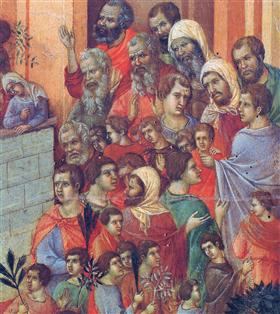
https://uploads4.wikiart.org/images/duccio/entry-into-jerusalem-fragment-1311-1.jpg!PinterestLarge.jpg
The Entry into Jerusalem -- Duccio
LITURGY OF THE PALMS
LITURGY OF THE PASSION

Though still commonly called Palm Sunday, in modern liturgical practice the Sunday before Easter Day is referred to as ‘The Sunday of the Passion’. This is because it is the first liturgical observance in the season of Holy Week and Easter when a Gospel narrative of the sufferings (passion) of Jesus is read.  The older title is not lost, however. This Sunday is unique in the Lectionary because it prescribes two Gospels, and the first of these -- for the Liturgy of the Palms – tells the story of Christ’s arrival in Jerusalem for the Passover. Riding on a donkey, and greeted with enthusiasm by a crowd waving palm branches, it is traditionally described as his ‘triumphal entry’.
It is only after modern worshipers have enacted this scene by taking part in their own procession, that they listen to the first Passion narrative of Holy Week – usually read or sung in a dramatic form by a number of different voices. Though this second Gospel, whether in the full or the abbreviated form, is much longer, the first is no less crucial in establishing the shape of our journey to Easter. On Palm Sunday we begin with triumph, but the triumph is short lived – and hollow. The Bible readings for days that follow reflect the rising tension, and contention, that surrounds Jesus. It culminates in the events of Maundy Thursday and Good Friday -- his betrayal, trial and death.

Crucifixion -- Durer
It is vitally important to see that in this intervening period, his enemies not merely gain the upper hand; in the world’s terms they are also victorious. What better outcome for those who see Jesus as a radical traitor to their faith, and a threat to their political security, than that he should be killed in the brutal way reserved for the worst of criminals? And what greater evidence of his missionary failure, than that his most loyal disciples abandon him in fear and wretchedness, and even deny that they ever knew him?
We need to grasp the depth of the degradation, pain and failure, to which Jesus is subjected, together with the strength of his unwavering obedience to God, in order properly to understand both the shallowness of his ‘triumphal’ entry on Palm Sunday, and the significance of his Resurrection on Easter Day. By this mighty act God shows where true victory is to be found. It remains, of course, for us to find the grace to long for it.

Monday, March 27, 2017

LENT V 2017


Lazarus, Come Forth - Salvador Dali
In Year A of the Revised Common Lectionary the Gospel readings for Sundays in Lent include three unusually lengthy episodes. They all relate personal encounters with Jesus, through which a deep theological point is revealed. On the third Sunday, Jesus encounters the Samaritan woman at the well. On the fourth, it is the man born blind. On this, the fifth Sunday in Lent, it is the raising of Lazarus from the dead, an encounter not just with an individual, but with the whole household at Bethany – Mary, Martha, Lazarus -- all special friends of Jesus.
In each of these stories there is a miraculous element, and the dramatic nature of the miracle intensifies from one episode to the next. Jesus, somehow, knows the Samaritan woman’s personal history without asking. This impresses her greatly, but it pales in comparison with the miraculous gift of sightedness to a man who had never been able to see. The restoration of Lazarus from death to life is more dramatic still, but it also has special significance for John's Gospel as a whole. In Matthew, Mark and Luke, it is overturning the tables in the temple that finally leads the Jewish authorities to the conclusion that Jesus must die. In John's, it is the raising of Lazarus that brings them to the same conclusion. Why is this?

Vision of the Valley of Dry Bones Gustave Dore
In the verses that follow, John goes on to tell us.The Jewish leaders are afraid that Jesus' growing popularity as a miracle worker will lead the Roman imperial authorities to fear rebellion, and order a violent suppression of the Jewish nation. So they conclude that action must be taken against Jesus. Caiaphas the high priest comes up with a more sophisticated proposal; they can best protect the nation by contriving to have Jesus condemned to death by the Roman authorities as a rebel.

If the raising of Lazarus is what gives rise to this plan, it also reveals its futility. Ezekiel’s vision of the valley of dry bones into which the Spirit of God breathes life, places Jesus’s miracle beyond mere revival and into the context of redemption. The passage from Paul’s letter to the Romans invites us to go further. It challenges us to think quite differently about life and death. “To set the mind on the flesh is death" he says, "but to set the mind on the Spirit is life and peace. . . . If Christ is in you, though the body is dead because of sin, the Spirit is life because of righteousness.”

Lazarus’s corrupting body, then, is not the only form of death. Nor is it the worst. Jesus displays God’s creative power in a spectacular act that reverses the normal processes of nature. Yet the point is not to give Lazarus a few extra years. It is to show that a quite different life-giving transformation is on offer and to warn us, paradoxically, against clinging desperately to this mortal life. The raising of Lazarus is a sign of this truth. Its ultimate vindication is still to come. The plotting of the chief priests and Pharisees seems to succeed in the Crucifixion, only to be followed by another, far more significant 'rising from the dead' -- Christ's own Resurrection

Tuesday, March 21, 2017

LENT IV 2017


Family of the Blind Man -- Picasso
The Gospel for this Sunday is a miracle story that turns into a perplexing parable. A man who is literally blind is given sight for the first time in his life. The Pharisees are highly suspicious of Jesus. So they look for ways to discredit this miraculous deed, while at the same time dispelling any idea that he might be the Messiah. First they doubt if the man really was blind, and then they try to get him to admit that Jesus is religiously at fault, since he has committed a sin by healing on the Sabbath. The miracle cure, then,  is no reason to praise him. The man makes a memorable response "I do not know whether he is a sinner. One thing I do know, though I was blind, now I see."


When finally the Pharisees engage with Jesus himself, it appears that the whole episode is not primarily a healing miracle at all, but a parable in action, one about spiritual sight and spiritual blindness. Puzzlingly, Jesus says that those who are blind will be able to see, and that those who can see will prove blind. How are we to understand this? An important clue comes right at the start of the passage. The blind man is not blind because he is a sinner. Though it looks like a curse, his blindness is in reality a very special attribute, since through it Jesus will reveal the works of God. The content of that revelation is that Jesus is the one true light. That is to say, it is by close attention to the works and words of Jesus, not by scrupulous attention to religious regulations, that we can discern God’s will for us. By refusing to acknowledge this, the sighted Pharisees show themselves to be purblind, unwilling to see. By acknowledging it, the blind man, paradoxically, shows himself to have spiritual insight that the physically sighted lack.

Sketch for Light Conquers Darkness - Roerich
Spiritual sightedness, no less than physical sightedness, concerns reality -- the truth about ourselves, the lives we lead, and the world we live in. Like ordinary eyesight, it requires light by which to see. Yet sinfulness flees from the light, because it prefers that the truth should remain hidden. The short passage from the Epistle to the Ephesians reflects this dichotomy, and turns it into a choice with which we are confronted. “Christ will shine on you” verse 14 declares. For those who want the truth, these words represent a liberating promise. For those engaged in “works of darkness”, however, these very same words constitute a threat. The choice is clear, and real. We can continue to act according to our own light, and inevitably stumble around in darkness. Or we can avail ourselves of the light of Christ, and gladly embrace the truth that it reveals, however painful or uncomfortable that might be for us.

Monday, March 13, 2017

LENT III 2017

Chagall -- Moses and the Striking Rock
Symbols are indispensable to theology and religion, because often it is only through symbols that we can talk about both the world in which we live, and the reality that transcends it. In the Bible, ‘bread’, ‘water’, and ‘light’ are used symbolically again and again. It is easy to see why. All of them are essential to biological life, and so they readily lend themselves as means by which to point beyond the biological, to the essential elements of spiritual life.
The Old Testament lesson and the Gospel for this week are linked by one of these symbols – water. Moses, tormented by yet more complaining demands on the part of those he has led out of slavery – on this occasion it is “Give us water” -- cries out to God in his frustration. God responds by aligning himself (almost literally) with a miraculous supply of water in the wilderness. “I will be standing there in front of you on the rock at Horeb”, he tells Moses, “Strike the rock, and water will come out of it”. Thereby, the Israelites’ biological need for water is satisfied, but also made the means of demonstrating their dependence upon God.
 
Jesus and the Samaritan Woman -- Duccio
The episode reveals both God's providential generosity  and the weakness and waywardness of the Israelites. They have taken it upon themselves to test God, and thus expose their underlying faithlessness. The Gospel passage offers us an interesting reversal. Here too the symbol of water plays its part, and the need for it is made the means of a test. But it is God in the Person of Jesus who needs water, and the humble Samaritan woman who is asked to provide it. Being Samaritan, she is not one of the ‘Chosen’ people, but part of a group regarded by Orthodox Jews as renegades. 
 
Nevertheless, she passes the initial test by drawing water from the well. This proves her worthiness to be put to a deeper test. Does she long for ‘living’ water of a different kind, and can she see that Jesus is offering it? The woman is convinced, almost, by the extraordinary insight Jesus shows into her life and character. This gives us a clue to the nature of the ‘eternal life’ to which Jesus refers --  life in God. In the Epistle, St Paul’s description of this life also makes an implicit reference to water. “We have obtained access to this grace in which we stand; and we boast in our hope of sharing the glory of God . . . because God's love has been poured into our hearts through the Holy Spirit that has been given to us”.

Monday, March 6, 2017

LENT II 2017

Abraham and the Angels -- Marc Chagall (1966)

This week’s Old Testament lesson is remarkably short – just four sentences. It records God’s call to Abram to leave his home country and set off on a journey – who knows where – solely on the strength of God’s promise that his descendants would become “a great nation”.  God’s promise could hardly have been more spectacularly fulfilled. Abraham (as he is later renamed) must have had many contemporaries who were also leading figures in their day. But we know nothing about them because they left no discernible trace on the world they once inhabited. If -- as Paul insists – we include Christians among Abraham’s descendants, then the ‘great nation’ that grew from his obedience to God’s call, amounts, in our day and age alone, to well over two billion human beings in every country of the world.

“If Abraham was justified by works, he has something to boast about, but not before God”, Paul writes in this week’s Epistle. Abraham could rightly take pride in the fact that he had the strength of mind and will to set out into the unknown. But it is the ultimate significance of this decision in which Paul is interest, and the key to this is not strength of character, but the power and purposes of God. The outcome of Abraham’s historic decision “depends on faith”, not on ingenuity or hard work. The humanly momentous decision to leave his homeland home only matters “in order that the promise may rest on grace”.
Christ and Nicodemus  - Ilya Repin (1887)
Paul is confident, of course, that the ultimate embodiment of faith and hence of grace is Jesus. In the the Gospel passage we encounter another figure, Nicodemus. No less well versed in Judaism than Paul, he is much less confident about Jesus. He is still wondering what to make of him, and that explains, no doubt, why as a devourt and learned Jew, he decides to seek him out at night. 

Nicodemus makes two further appearances in John's Gospel, and in each one, he steps a little closer to discipleship -- though never completely or unreservedly. On this first occasion Jesus asks him, "Are you a teacher of Israel, and yet you do not understand these things?" The implication  is clear. Anyone who wants to penetrates the faith of Israel must be driven on to find its fulfillment in Jesus. The heart of the transformation is this: fear of judgment is turned into hope of salvation. As John puts it: “God did not send the Son into the world to condemn the world, but that the world might be saved through him”.