Monday, May 22, 2017

EASTER VII 2017

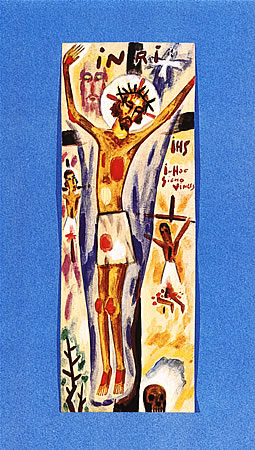
In older calendars the period following Ascension Day was a distinct liturgical season. Nowadays, though the theme of Ascension is still prominent, this Sunday is demarcated as the last Sunday in the season of Easter. Appropriately the Lectionary chooses Bible readings that will link the beginning of the season with its close. The passage from the first chapter of Acts recounts the final Resurrection appearance that Jesus made to his disciples – the occasion of his ascension to the Father. The Gospel passage – from John – is linked to this event by having a similar theme. Jesus expressly says “I am coming to you, Holy Father”. A key difference between the two passages, however, is that in the Gospel, he says this before his trial, Crucifixion and Resurrection, a point in time time when he still has a long and arduous path to tread. Yet importantly it is at this moment, and not the Ascension in Acts, that Jesus declares “Now I am no longer in the world”. What can he mean? Even when he has risen from the dead, he appears in Galilee. Doesn’t his departure from ‘the world’ have to wait for Ascension?

Jesús Crucifio, 1920 - Xul Solar
Jesus Crucifio Xul Solar (1920)
The answer to this question, and the key to the mystery that underlies it, needs a proper understanding of the relation between heaven and earth. Though ‘flesh’ and ‘spirit’ are often at war within us, contrary to what people commonly suppose, this does not mean that the spiritual, heavenly realm is radically divorced from the material, earthly one. This week’s Gospel makes it plain that Heaven is not somewhere we travel to at death, a place just like Earth only purged of all its imperfections. On the contrary, Jesus came not to promise, but “to give eternal life”. And then the Gospel adds: “This is eternal life, that they may know you, the only true God, and Jesus Christ whom you have sent.”  In other words, knowing God does not mean waiting until we die. Rather, in Christ the human spirit is offered a way of living now that will continue and prove indifferent to death whenever that comes. 


How are we truly to know God in Christ? Part of the answer lies in our own conduct. This week’s Epistle says “Discipline yourselves, keep alert”. This advice can only be part of the answer. The real Good News, thankfully, is that we are not at the mercy of our own, often feeble, efforts. When the spirit is willing but the flesh is weak, which is a lot of the time, then “cast all your anxiety on him, because he cares for you”. Jesus is properly called Savior because he loves us in precisely the way that God does. Some familiar analogies illuminate the idea. While we hold out our hands, it is he who reaches down to us; we open our hearts, but it is his saving spirit that enters them. That, at any rate, is the promise of Pentecost, the season just about to come. 

ASCENSION DAY 2017

Ascension day (Easter) - Niko Pirosmani
Ascension Day --Niko Pirosmani

Ascension Day is one of the principal feasts of the Christian Calendar. Yet, while this means it is to be ranked alongside Christmas, Easter  and and Pentecost, it has rarely been accorded the same sort of importance in the life of the Church or the practice of individual Christians. Perhaps this is in part because the event it commemorates -- the ascension of the risen Jesus -- is recorded by only one evangelist, Luke (though that is also true of the Epiphany). Perhaps it is because over the centuries its precise location in the Christian year has been subject to local variation. But mainly, I think, it is because the theological significance of the event it celebrates is very hard to separate from the Easter Resurrection and the coming of Holy Spirit at Pentecost.

One way of identifying this significance, however, is to note the special way in which the brief period between Ascension Day and Pentecost unites us, and Christians of every age, with the first disciples. Peter, John Andrew and so on, saw Jesus in the flesh. They walked and talked with him, watched and listened to him over the years of his ministry. It ended in apparent failure of course, but then, as physical witnesses of the Risen Christ, they were granted a second opportunity to be in the privileged company of the Son of God.

In the pursuit of our discipleship we do not have these advantages. We must live in faith in a way that those few Galileeans did not have to do. Ascension marks the point at which Jesus left them to complete their discipleship, by finding a faith just like ours. His departure "from their sight"  meant that  for a time they had to stand firm in knowledge of the Resurrection, without his unique presence to sustain them. In this way, his ascension required them to prepare themselves for what the rest of us rely on -- a Holy Spirit that draws us into the eternal life of the Father whom we do not see and the Son whom we never met.

Tuesday, May 16, 2017

EASTER VI

Figures on the Terrace by the Acropolis -- Lawrence Alma-Tadema


In the passage from Acts for this Sunday Paul preaches in front of the Areopagus, a rocky platform beside the Acropolis in Athens. This is a key moment in the history of Christianity and the world. Two great cultures meet for the first time -- the religion of the Jews and the philosophy of the Greeks.  Athens and Jerusalem are the streams of thought and culture from which all the most important aspects of our civilization take their origin – philosophy, theology, history, the arts, the sciences and technology. Both Jew and Greek were passionately concerned to understand how the lives of human beings could be rooted in reality, how they could transcend individual fads and passing fashions, and be lived in harmony with the whole creation. 

St Peter -- Crivelli
When the Epistle for this Sunday says “even if you do suffer for doing what is right, you are blessed” it could be taken to be stating one of Socrates’ most fundamental ideas. This shows that -- despite Tertullian's famous question "What has Athens to do with Jerusalem?" -- in certain ways Jew and Greek were not so far apart. But while the Greeks looked to philosophy to understand the world (today it is science to which people turn), Peter thinks a more fundamental requirement is that ‘in your hearts you sanctify Christ as Lord’.

Paul is clear about this vital shift of perspective. “The God who made the world and everything in it, he who is Lord of heaven and earth . . .will have the world judged in righteousness by a man whom he has appointed, and of this he has given assurance to all by raising him from the dead”. The implication of this is that humanity needs more than science or philosophy, valuable though these are.  At bottom, the ‘Spirit of truth’ is not something impersonal – knowledge -- but something personal -- love. It is only when we grasp this profound insight that our experience of human nature (who we are) and of the human condition (the world in which we find ourselves) can be fully reconciled. The world that God has made for us may be studied as a physical system governed by causal laws of "matter in motion". There is undoubtedly a lot to be learned from studying it that way. But the Christian religion holds that inquiries of this kind cannot sound reality's depths. Rather,  the world is a cosmic expression of Divine love, and animated by that love.

In the Gospel, Jesus identifies the Spirit of Truth as a Holy Spirit and promises a truly remarkable kind of intimacy with this love. We are not orphans in an alien cosmos because, he says, ‘I am in my Father, and you in me, and I in you’. That is why Peter thinks that a 'sanctified heart' matters more than intellectual understanding.


Monday, May 1, 2017

EASTER IV 2017

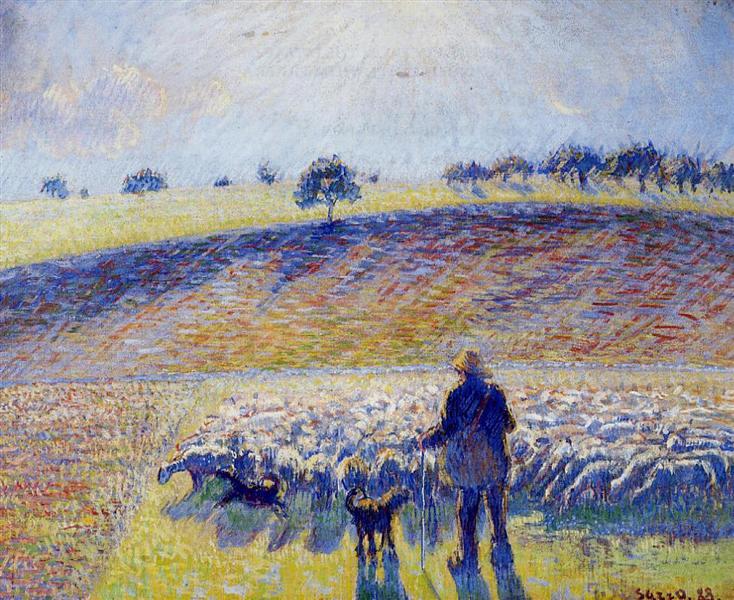
Shepherd and Sheep, 1888 - Camille Pissarro
Pisarro - Shepherd and Sheep
The 4th Sunday in Easter is always “Good Shepherd” Sunday, so called because the appointed Psalm is the 23rd – ‘The Lord is my Shepherd’. Many churches underline the theme by choosing “shepherd” hymns, which are often metrical versions of Psalm 23, in fact. In the three years of the lectionary cycle, the Gospel passage – which is always from John – differs slightly, but it never fails to include Jesus’ application of the metaphor of the shepherd to himself. This year John tells us that “Jesus used this figure of speech with them, but they did not understand what he was saying to them”. How much harder must it be for us to understand it, since we live in a world that – even in rural areas – is very far removed from the ancient world where the biblical shepherd was a common sight.
 
Thanks to the enduring popularity of the 23rd Psalm, the language of sheep and shepherd is still familiar and comforting to many church people. Yet this very familiarity can prevent us from grasping its essential feature. Sheep have a poor image in the modern world -- foolish, easily frightened, inclined to bolt -- so that shepherds have to control them, assisted often by dogs nipping at the heels of the witless sheep. Shepherds in biblical times, however, did not drive their sheep; they led them, to sources of fresh water that they were unlikely to find themselves. It was also the shepherd's job to protect them from hazards too great for the sheep themselves. It was the shepherd's superior wisdom and care that made this possible. Without it, the sheep could be expected to “go astray, each to his own way” (Isaiah 56:3).
 
The message is not an entirely easy one for a modern audience. We are resistant to being driven, but we are not much better disposed to being led. The contemporary spiritual climate emphasizes seeking, searching, questing and questioning. A spiritual 'journey' is something we undertake on our own initiative. The image of the Good Shepherd runs counter to this. Like the shepherd, it is God who finds us, not we who find God. Our task is to be able to recognize His call, and then to follow the divine Word as it uniquely comes to us through Christ. Any attempt to establish a spiritual path of our own devising will only lead to dangerous wandering. 
 
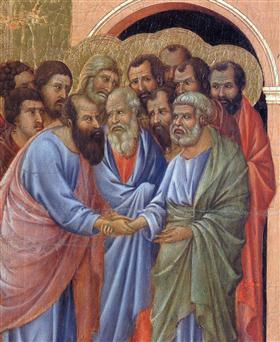
The arrival of the apostles to the Virgin (Fragment) - Duccio
In this year of the Lectionary, the brief passage from Acts gives us a sense of the excitement and urgency with which the first converts heard this call. Two thousand years on there cannot be that same urgency. But the passage also gives us a clear indication of what has lain at the heart of Christian practice, even from the earliest times -- “teaching, fellowship, breaking of bread and prayers”.


Duccio -- Apostles

Monday, April 24, 2017

EASTER III 2017


Duccio -- Road to Emmaus
The Gospel story for this Sunday recounts one of the best known and most intriguing of Christ’s Resurrection appearances – the Road to Emmaus. It has inspired hundreds of artists, including great masters such as Duccio, Titian, Caravaggio, Velasquez and Rembrandt. This popularity among painters made it a perfect subject for the world’s most famous art forgery – a ‘Disciples at Emmaus’ ostensibly by the celebrated Vermeer, but in reality by the unknown van Meegeren. 
The episode is unique to Luke, and what makes it so intriguing is its ordinariness. Last week’s Gospel (from John) related Christ’s appearance in an upper room behind locked doors. There is mysteriousness about this that provides the context for Thomas’s understandable doubts. Luke’s account of the Emmaus appearance is quite different. To begin with, these ‘disciples’ were not among the twelve, and though their sadness and puzzlement about the death of Jesus is palpable, the journey they are on seems to be for some practical purpose of everyday life. Most striking of all is this. Unlike the disciples in the upper room, they do not recognize Jesus straight away, but walk with him along the road for quite some time, assuming he is just another traveler. Their moment of recognition comes when they suddenly recognize the characteristic way in which he performs the familiar act of breaking a loaf of bread for supper.


Velasquez Supper at Emmaus

The appearance of Christ to these unnamed disciples resonates well with the vast majority of Christians.  Ordinary people, who are neither saints nor mystics, may think and wonder about Jesus certainly, but most of the time they are just getting on with the business of life. The Road to Emmaus alerts us to the possibility that the presence of Christ in the world can also be experienced in ordinary life  -- suddenly, and surprisingly, as He is revealed in the people and events of everyday. Often this will be in unexpected places, or even, as Mother Theresa memorably said, in ‘his most distressing disguise’.


These little ‘epiphanies’ invite us to repeat the same ‘question and answer’ that we find in today’s reading from Acts -- “What should we do?”. Peter’s answer to his hearers was “Repent, and be baptized every one of you in the name of Jesus Christ so that your sins may be forgiven”. For those who were baptized long ago, often in infancy, this cannot be the immediate response. Nevertheless, as the practice of renewing baptismal vows implies, we need to acknowledge again and again the truth of which this week's Epistle reminds us. We have been saved from futile ways of life by the ‘death of Jesus’, and not by any ‘silver or gold’, even if this is what much of our time is spent trying to secure. Fully grasping this deep truth requires spiritual renewal. The Disciples at Emmaus provide a compelling model of how that can happen, surprising us 'on the road'. With such renewal we are enabled once more to make our own voices the voice of today’s Psalmist “O LORD, I am your servant. You have loosed my bonds.”