Monday, January 27, 2014

CANDLEMAS 2014


Presentation of Christ Mantegna (1431-1506)
Feb 2nd commemorates the presentation of Jesus at the temple in Jerusalem, a traditional observance of faithful Jews on the birth of a first son. With the hindsight of the Last Supper, the Presentation of Christ in the Temple can be seen to prefigure the Eucharist in which, day by day, Christians have the opportunity to give back to God back the gift He has given us. So Mary and Joseph return to God that which uniquely came from God.

Traditionally called ‘Candlemas’, the feast of the Presentation has several meanings. The lectionary readings are the same each year, and identify Jesus with ‘the Lord whom you seek’, the one whose unexpected appearance ‘in the temple’ is predicted by the prophet Malachi. The appointed Psalm, appropriately, extols the beauty and wonder of God’s ‘dwelling place’ and the joy of being there. The association with candles, carried in procession, comes from the fact that a central part of the Biblical episode recorded in the Gospel for the day is the aged Simeon's 'Nunc Dimittis' in which he articulates the remarkable insight that the baby he holds in his arms is 'a light to lighten the Gentiles and to be the glory of God's people Israel'.

Candlemas comes forty days after the nativity, and has long been regarded as the very last feast of the Christmas season. This is not just because it records a Jewish birth rite, but because Simeon's words summarize so memorably the truth of the Incarnation. In the ceremony for Candlemas, candles for use, at home as well as in church, throughout the coming year are blessed with this prayer:
 
God our Father,
Source of all light,
this day you revealed to Simeon the light of your revelation to the nations.
Bless these candles and make them holy.
May we who carry them praise your glory, walk in the path of goodness and come to the light that shines forever
Grant this through Christ our Lord.

Tuesday, January 21, 2014

EPIPHANY III 2014


He Qi 'Calling Disciples' (2001)
A little oddly, perhaps, the appearance of the disciples Andrew and Peter, which John's Gospel recounted last week, is repeated this week in Matthew's version.  There are some important differences between the two, however. Whereas the fourth evangelist tells the story in connection with John the Baptist, Matthew makes a very clear link with the prophet Isaiah, and declares Jesus to be the light that Isaiah prophesied would eventually dawn on those who sit 'in the region and shadow of death'. 

It is against this alternative background that Matthew introduces Andrew and Peter, but there is a further subtle and important difference. In John’s version, the initiative in becoming disciples is taken by Andrew and Peter. In Matthew’s version, it is Jesus who calls them, as he does James and John. What is more, he calls them to leave not only the work they are engaged in, but everything that they have. Their response is usually held up as exemplary. 'Immediately they left their nets and followed him'. But what about Zebedee who is left sitting in the boat?  Has he no claim on the sons he has raised, and on whose labor he will depend in old age?
 Matthew’s version of the call to the disciples is echoed in many other parts of the Gospel. Following Jesus is repeatedly spoken of as being all consuming, even to the point of abandoning family responsibilities. Doesn’t this mean that Christian discipleship requires a kind of fanaticism? How could we answer such a call ourselves, given our love for parents and children, our belief in the value of what we do, and our obligations to the wider community?


Vassily Polenv James and John (1904)
Elsewhere, confronted with questions like these, Jesus allows that for many people wholesale commitment of this kind is just not possible, but he promises that God can work with less than this. It is enough to start with simple penitence, seek more and more ways in which ordinary life puts Christ first, and relinquish rival claimants to our most fundamental allegiance. The Epistle for this Sunday illustrates just how easy it is to fall into subsidiary loyalties. The loyalties for which St Paul chastises the Corinthian Christians mean nothing to us now. But we have our own rivals for Christ’s headship – family, nation, profession, ethnic group, sports team. If few of us can respond as immediately as the twelve disciples did, we can at least resolve to take more steps in their direction. What matters, is where the heart is, and whether we can truly say with the Psalmist, ‘One thing I asked of the Lord, that I will seek after: to live in the house of the Lord all the days of my life’.

Tuesday, January 14, 2014

EPIPHANY II 2014

John the Baptist identifies the Lamb of God -- 
sculpture relief in Amiens cathedral, courtesy of Jean andAlexander Heard Library
Over the Christmas season and into the first weeks of Epiphany, the Lectionary readings bring to our attention a deep connection between Isaiah, John the Baptist, and Jesus. The readings for this week continue to build this bridge between Old and New Testaments. The passage from Isaiah sets out a much larger divine plan than previous prophets proclaimed. “It is too light a thing that you should be my servant to raise up the tribes of Jacob and to restore the survivors of Israel; I will give you as a light to the nations”. God’s love is no longer to be confined to the Children of Israel. He has called Isaiah to a far more ambitious prophecy, so that “My salvation may reach to the end of the earth."

St Andrew (1914) Natalia Gonsharova
In the Gospel reading, John the Baptist sees Jesus coming towards him and declares “Here is the Lamb of God”. The expression 'Lamb of God' is now so well-worn, it is easy to miss the religious implications of this extraordinary metaphor. It too forges a connection between past, present and future, and it does so by means of two powerful resonances deeply engrained in the consciousness of the Jews.  One is the memory of the Passover Lamb, the sprinkling of whose blood on the doorposts played a key part in the Israelites' liberation from slavery. The other is the Suffering Servant of the book of Isaiah, who is led like a Lamb to the slaughter. Thus John the Evangelist conveys the spiritual intensity that makes John the Baptist such a formidable figure, and that enables him to penetrate the true significance of Jesus before everyone else.

But this Gospel passage takes the bridge building a step further. Among the first to hear John’s metaphor are Andrew and Simon. It is given to the otherwise undistinguished Andrew to grasp the truth and tell his brother “We have seen the Messiah” – the “Anointed” for whom, as devout Jews, they have been taught to yearn since infancy. Together they take the first hesitant steps on a new spiritual journey. It is a journey that will bring them through the disillusionment of Passiontide to the total transformation of Easter.

Tuesday, January 7, 2014

EPIPHANY I 2014


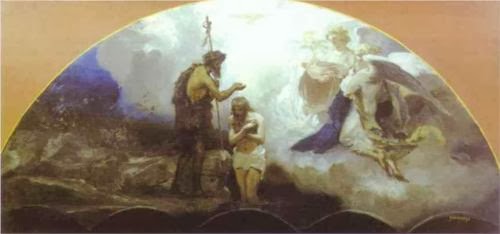
Baptism of Christ (1876) Henryk Siemiradzki,

The first Sunday after the Feast of the Epiphany is now widely observed as The Baptism of the Lord. It commemorates an event that is recorded in all four Gospels. Outside of the Passion narrative, relatively few episodes in the life of Jesus appear in all the Gospels, so this degree of Scriptural warrant is special.

The Gospel for this year is Matthew, but in fact, though the four Gospels record the baptism slightly differently, they all lay special emphasis on three aspects. First, they affirm a theological link between John the Baptist and the preparatory, prophetic ‘voice’ that Isaiah describes as ‘crying in the wilderness’. Secondly, they all speak of the highly charismatic John as nonetheless secondary to Jesus. Thirdly, they make the baptismal event a “manifestation”, that is to say, one of those very special occasions – like the Transfiguration – when Jesus’ divine nature and commission shone out unmistakably to all who were present. 

These three aspects are importantly connected. The prophet is a notable feature of Judaism, and as the reference to Isaiah implies, John stands out in this long and continuing line. Yet, with the appearance of Jesus, there is, so to speak, a change of gear. In the First Coming we move beyond the level of even the most distinguished prophets, and encounter not just another valuable source of spiritual insight and passionate human integrity, but a revelation of the Holy Spirit itself.

Ivanov John the Baptist
Written in retrospect, the Gospels struggle with this question – Just who was Jesus? Eventually they tentatively arrive at an answer which the Church has sought to refine ever since – Jesus is the Christ, the one human being in whom God is made fully manifest. In line with an ancient practice, baptisms are commonly celebrated on this Sunday. This is not just a matter of happily fitting the Gospel of the day. If Jesus is the perfect unity of humanity and holiness, our own lives become holy to the degree that they are lived in him. Baptism is the sacrament by which we are initiated into that life.

Tuesday, December 17, 2013

ADVENT IV 2013


Promenade of St Joseph and Jesus Murillo (1617-82)
The readings for this week form a bridge between Advent and Christmas. The Gospel begins the story of Christ’s Nativity which is about to unfold in longer readings on Christmas Eve, Christmas Day and then Epiphany. At the same time it looks back to the ancient promise of a Messiah, and directly quotes the prophet Isaiah in the famous passage that provides the Old Testament lesson for this Sunday.
Since we are still in Advent, we have only the start of the story in brief. Yet this short passage does something very special --  it enables us, unusually, to focus on the distinctive role of Joseph in the Gospel of God. Since Jesus owes his humanity, as well as his Jewish identity, to his earthly mother Mary, she has had a widely acknowledged theological role in the mystery of the Incarnation. Yet in a quite different way, Joseph also has a key part to play in God’s salvation history, since he too could have accepted or rejected it.


Swedish Madonna Anders Zorn (1900)
Nowadays, single parents and unmarried mothers are a thoroughly familiar part of life. As a result, it takes real imaginative effort to appreciate the significance of Mary’s highly unorthodox pregnancy in a culture so different to our own. At the annunciation Mary memorably says ‘be it unto me according to your word’. The great courage and deep faith that this reveals, is matched by Joseph’s response, however. Confronted with such devastating news, it would be natural for anyone to feel an intense personal affront and rejection. But Joseph had to face this further prospect -- acute embarrassment, ridicule, and social contempt.

All the time he had at hand an easy as well as a socially approved solution – ‘to dismiss her quietly’. The angelic voice in the dream tells him to do otherwise, but it relies, of course, on his having the spiritual insight and moral courage to accept that advice. His reward is to be accorded parental status by being giving the task of naming the baby. As it turns out, this is no small reward. Paul declares to the Christians at Rome in this week’s Epistle that their whole calling – like ours – is ‘for the sake of that name’. And at the name of Jesus, he tells us elsewhere, every knee shall bow.

Monday, December 9, 2013

ADVENT III 2013


‘What did you go out to look at?’ Jesus asks the crowd in this week’s Gospel, ‘A reed shaken in the wind?”  It is an image that has caught the imagination, and provided books and poems, as well as sermons, with a striking title. But what exactly does it mean? The exchange occurs in a section of Matthew’s Gospel that is mostly about the significance of John the Baptist. Clearly, ordinary people were much struck by this extraordinary man, and here Jesus is prompting them to ask themselves why.

Some commentaries suggest that from time to time freak winds blowing through the reeds around the Sea of Galilee created strikingly unusual formations. On this interpretation, Jesus is saying to the people ‘Surely you didn’t go to see John as some kind of freak?’ But they can hardly have been drawn by his social stature either. No one could have been less like the political dignitary who dresses in soft robes and lives in a royal palace. No, they went to see a prophet. And that means, consciously or unconsciously, they went to see him out of spiritual longing.

The Prophet Isaiah (1513) -- Grunewald
This week’s Old Testament lesson is one of Isaiah's most famous passages, and one with which the crowd would have been thoroughly familiar. It gives graphic expression to that longing “Then shall the eyes of the blind be opened, and the ears of the deaf unstopped, the lame shall leap like a deer and the tongue of the speechless sing for joy’. John is the harbinger of this vision, Jesus its fulfillment. The fulfillment is not all sweetness and light, however. ‘Here is your God, come with vengeance, and terrible recompense’.

Once again, the themes of the first and second comings are interwoven. The First Coming of carols, social festivities, and the baby in the manger falls easily within our comfort zone. We know what to expect, and we like what we know. The Second Coming when (as the Epistle puts it) ‘the Judge is standing at the doors!’ is a much more unsettling affair, inevitably generating a mixture of personal anxiety and spiritual incomprehension.

Advent is the opportunity to switch familiarity and surprise around.  Since divine judgment on the shabby lives human beings so often lead is precisely what it is reasonable to expect, we ought to find the Incarnation – God with us -- spiritually surprising.