Tuesday, February 11, 2014

EPIPHANY VI

Rembrandt St Paul at his writing desk

In this week’s Epistle St Paul tells the new Christians at Corinth that, when he first preached to them, he had to treat them “as infants in Christ.”  “I fed you with milk” he says, “not solid food, for you were not ready for solid food.” It is easy to imagine some of them bridling at this remark, just as a modern congregation might take serious offence if a priest or preacher spoke to them in this way. ‘Who are you to assume such a superior tone?’ would be a natural reaction.


Yet, though such a response is understandable, there is a very important lesson to be learned here. We happily concede that when it comes to medicine or law, business management, physical fitness, or playing an instrument, there are beginners and there are experts. No one would commit their affairs to a lawyer, physician or financial adviser who wasn’t an expert, no matter how friendly, caring, or amusing they might be. Are we to suppose that these, undoubtedly welcome, personality traits are enough when it comes to spiritual guidance? Can religious experience not lead to spiritual wisdom too?


The Ten Commandments Lucas Cranach the Elder 1472-1553
In the passage from Matthew’s Gospel, Jesus shares Paul’s assumption that there is such a thing as spiritual and moral development. This kind of development is a matter of moving on from the level of behaving decently and performing the right actions, to a deeper state of mind and heart. Moses (in the Ten Commandments) was right. Outward actions are important – murdering, committing adultery, swearing falsely are all things to be avoided. Still, simply observing the rules, however valuable, cannot be enough for those whose minds are set on the things of the spirit. God is a spirit, and those who worship God must worship God in spirit.


The evangelical message for the Church today is plain. The ‘inclusiveness’ of which so much is made is essential, but it is just a start, and never the last word. Welcoming people of ‘all sorts and conditions’ to the church has to be followed by setting out the spiritual challenges of Christian discipleship. Without continual growth we, and they, will remain pretty much as before -- ‘people of the flesh’ and at best ‘infants in Christ.’
 

Monday, February 3, 2014

EPIPHANY V 2014


For several weeks, the Sunday readings have been forging a connection between the Old Testament and the New. In the Gospel for this week, Jesus himself makes the connection. “Do not think that I have come to abolish the law or the prophets; I have come not to abolish but to fulfill”. But then he adds a seemingly impossible demand –“unless your righteousness exceeds that of the scribes and Pharisees, you will never enter the kingdom of heaven”.


     How are we to understand this? The passage from Isaiah suggests one solution.  It ridicules ‘bowing down the head like a bulrush’ and ‘lying in sackcloth and ashes’, and instead praises ‘sharing your bread with the hungry’, and ‘bringing the homeless poor into your house’. ‘Is not this the fast that I choose’ God declares ‘to loose the bonds of injustice, to undo the thongs of the yoke, to let the oppressed go free, and to break every yoke?’


     This ‘ethical version of ‘righteousness’ is likely to prove far more attractive to the modern mind than either the ritual observances of the Jews, or the austere devotional practices of the Desert Fathers or the Celtic hermits. And yet, we know in our hearts that most of us are as unlikely to make the kind of sacrifices that this high ethical ideal requires, as we are to build shrines among desert rocks, or stand in icy water to say our prayers. The greatest possible effort will no more enable us to exceed this alternative standard of righteousness than it will the righteousness of the scribes and Pharisees. The Gospel passage, in short, still reads like a council of despair.


Yet this very fact can serve to point us in a different direction. In his letter to the Corinthians, St Paul openly acknowledges his ‘weakness and fear’. It is in fact a first essential step to putting his faith in Jesus Christ, and so believing that Christ’s perfection can overcome his imperfection. It is sometimes suggested that this is just using Jesus to get us off the hook. The Gospel passage, however, still assigns us a vital role in the economy of salvation – not to be perfect, but to be ‘the salt of the earth’ and ‘the light of the world’. The reality is that our lives as Christians will never be models of rectitude. But they can still ‘give light to all in the house’ by reflecting what St Paul calls ‘the mind of Christ’. By making us honest, accepting our frailty enables us to give the glory where it truly belongs -- to our Father in heaven.
  
Pictures 'Moses delivering the Tablets of the Law to the Elders -- Marc Chagall, and ‘Now you are the light of the world and salt of the earth’, abstract by  Lalo Gutierrez

Monday, January 27, 2014

CANDLEMAS 2014


Presentation of Christ Mantegna (1431-1506)
Feb 2nd commemorates the presentation of Jesus at the temple in Jerusalem, a traditional observance of faithful Jews on the birth of a first son. With the hindsight of the Last Supper, the Presentation of Christ in the Temple can be seen to prefigure the Eucharist in which, day by day, Christians have the opportunity to give back to God back the gift He has given us. So Mary and Joseph return to God that which uniquely came from God.

Traditionally called ‘Candlemas’, the feast of the Presentation has several meanings. The lectionary readings are the same each year, and identify Jesus with ‘the Lord whom you seek’, the one whose unexpected appearance ‘in the temple’ is predicted by the prophet Malachi. The appointed Psalm, appropriately, extols the beauty and wonder of God’s ‘dwelling place’ and the joy of being there. The association with candles, carried in procession, comes from the fact that a central part of the Biblical episode recorded in the Gospel for the day is the aged Simeon's 'Nunc Dimittis' in which he articulates the remarkable insight that the baby he holds in his arms is 'a light to lighten the Gentiles and to be the glory of God's people Israel'.

Candlemas comes forty days after the nativity, and has long been regarded as the very last feast of the Christmas season. This is not just because it records a Jewish birth rite, but because Simeon's words summarize so memorably the truth of the Incarnation. In the ceremony for Candlemas, candles for use, at home as well as in church, throughout the coming year are blessed with this prayer:
 
God our Father,
Source of all light,
this day you revealed to Simeon the light of your revelation to the nations.
Bless these candles and make them holy.
May we who carry them praise your glory, walk in the path of goodness and come to the light that shines forever
Grant this through Christ our Lord.

Tuesday, January 21, 2014

EPIPHANY III 2014


He Qi 'Calling Disciples' (2001)
A little oddly, perhaps, the appearance of the disciples Andrew and Peter, which John's Gospel recounted last week, is repeated this week in Matthew's version.  There are some important differences between the two, however. Whereas the fourth evangelist tells the story in connection with John the Baptist, Matthew makes a very clear link with the prophet Isaiah, and declares Jesus to be the light that Isaiah prophesied would eventually dawn on those who sit 'in the region and shadow of death'. 

It is against this alternative background that Matthew introduces Andrew and Peter, but there is a further subtle and important difference. In John’s version, the initiative in becoming disciples is taken by Andrew and Peter. In Matthew’s version, it is Jesus who calls them, as he does James and John. What is more, he calls them to leave not only the work they are engaged in, but everything that they have. Their response is usually held up as exemplary. 'Immediately they left their nets and followed him'. But what about Zebedee who is left sitting in the boat?  Has he no claim on the sons he has raised, and on whose labor he will depend in old age?
 Matthew’s version of the call to the disciples is echoed in many other parts of the Gospel. Following Jesus is repeatedly spoken of as being all consuming, even to the point of abandoning family responsibilities. Doesn’t this mean that Christian discipleship requires a kind of fanaticism? How could we answer such a call ourselves, given our love for parents and children, our belief in the value of what we do, and our obligations to the wider community?


Vassily Polenv James and John (1904)
Elsewhere, confronted with questions like these, Jesus allows that for many people wholesale commitment of this kind is just not possible, but he promises that God can work with less than this. It is enough to start with simple penitence, seek more and more ways in which ordinary life puts Christ first, and relinquish rival claimants to our most fundamental allegiance. The Epistle for this Sunday illustrates just how easy it is to fall into subsidiary loyalties. The loyalties for which St Paul chastises the Corinthian Christians mean nothing to us now. But we have our own rivals for Christ’s headship – family, nation, profession, ethnic group, sports team. If few of us can respond as immediately as the twelve disciples did, we can at least resolve to take more steps in their direction. What matters, is where the heart is, and whether we can truly say with the Psalmist, ‘One thing I asked of the Lord, that I will seek after: to live in the house of the Lord all the days of my life’.

Tuesday, January 14, 2014

EPIPHANY II 2014

John the Baptist identifies the Lamb of God -- 
sculpture relief in Amiens cathedral, courtesy of Jean andAlexander Heard Library
Over the Christmas season and into the first weeks of Epiphany, the Lectionary readings bring to our attention a deep connection between Isaiah, John the Baptist, and Jesus. The readings for this week continue to build this bridge between Old and New Testaments. The passage from Isaiah sets out a much larger divine plan than previous prophets proclaimed. “It is too light a thing that you should be my servant to raise up the tribes of Jacob and to restore the survivors of Israel; I will give you as a light to the nations”. God’s love is no longer to be confined to the Children of Israel. He has called Isaiah to a far more ambitious prophecy, so that “My salvation may reach to the end of the earth."

St Andrew (1914) Natalia Gonsharova
In the Gospel reading, John the Baptist sees Jesus coming towards him and declares “Here is the Lamb of God”. The expression 'Lamb of God' is now so well-worn, it is easy to miss the religious implications of this extraordinary metaphor. It too forges a connection between past, present and future, and it does so by means of two powerful resonances deeply engrained in the consciousness of the Jews.  One is the memory of the Passover Lamb, the sprinkling of whose blood on the doorposts played a key part in the Israelites' liberation from slavery. The other is the Suffering Servant of the book of Isaiah, who is led like a Lamb to the slaughter. Thus John the Evangelist conveys the spiritual intensity that makes John the Baptist such a formidable figure, and that enables him to penetrate the true significance of Jesus before everyone else.

But this Gospel passage takes the bridge building a step further. Among the first to hear John’s metaphor are Andrew and Simon. It is given to the otherwise undistinguished Andrew to grasp the truth and tell his brother “We have seen the Messiah” – the “Anointed” for whom, as devout Jews, they have been taught to yearn since infancy. Together they take the first hesitant steps on a new spiritual journey. It is a journey that will bring them through the disillusionment of Passiontide to the total transformation of Easter.

Tuesday, January 7, 2014

EPIPHANY I 2014


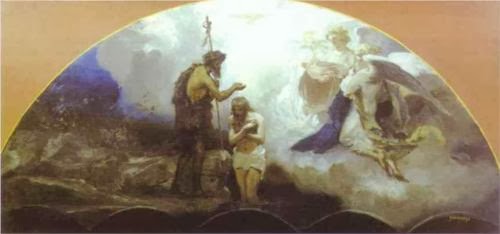
Baptism of Christ (1876) Henryk Siemiradzki,

The first Sunday after the Feast of the Epiphany is now widely observed as The Baptism of the Lord. It commemorates an event that is recorded in all four Gospels. Outside of the Passion narrative, relatively few episodes in the life of Jesus appear in all the Gospels, so this degree of Scriptural warrant is special.

The Gospel for this year is Matthew, but in fact, though the four Gospels record the baptism slightly differently, they all lay special emphasis on three aspects. First, they affirm a theological link between John the Baptist and the preparatory, prophetic ‘voice’ that Isaiah describes as ‘crying in the wilderness’. Secondly, they all speak of the highly charismatic John as nonetheless secondary to Jesus. Thirdly, they make the baptismal event a “manifestation”, that is to say, one of those very special occasions – like the Transfiguration – when Jesus’ divine nature and commission shone out unmistakably to all who were present. 

These three aspects are importantly connected. The prophet is a notable feature of Judaism, and as the reference to Isaiah implies, John stands out in this long and continuing line. Yet, with the appearance of Jesus, there is, so to speak, a change of gear. In the First Coming we move beyond the level of even the most distinguished prophets, and encounter not just another valuable source of spiritual insight and passionate human integrity, but a revelation of the Holy Spirit itself.

Ivanov John the Baptist
Written in retrospect, the Gospels struggle with this question – Just who was Jesus? Eventually they tentatively arrive at an answer which the Church has sought to refine ever since – Jesus is the Christ, the one human being in whom God is made fully manifest. In line with an ancient practice, baptisms are commonly celebrated on this Sunday. This is not just a matter of happily fitting the Gospel of the day. If Jesus is the perfect unity of humanity and holiness, our own lives become holy to the degree that they are lived in him. Baptism is the sacrament by which we are initiated into that life.